

The rising popularity of GLP-1–based medications is reshaping not only how people approach weight loss, but how the food industry is beginning to respond. From supermarket ready meals to functional food innovation, a new intersection is emerging between nutrition and pharmaceuticals—one that consumer demand is accelerating faster than regulation can currently follow.
A glance at supermarket shelves this January already reveals early signs of this shift. Several retailers and specialist brands have launched product ranges aligned with GLP-1 eating patterns, emphasising smaller portions, higher protein content and nutrient density. These launches reflect real changes in eating behaviour—but they also expose missed opportunities in how nutrition, sustainability and regulatory compliance are being navigated.
What GLP-1 is—and why it is reshaping the food market
GLP-1 (glucagon-like peptide-1) is a hormone naturally produced in the small intestine that plays a key role in appetite regulation and satiety signalling. Medical products that mimic its effects—such as semaglutide and liraglutide—reduce hunger and help regulate food intake, contributing to weight loss.
As use of these medications becomes more widespread, consumer behaviour is shifting accordingly. People are eating smaller portions and increasingly gravitating towards foods perceived as functional, nutrient-dense and protein-rich. This is already influencing product development, with food manufacturers exploring formulations positioned as compatible with GLP-1 therapy.
In the US, this trend has become more explicit. Nestlé launched its Vital Pursuit brand in 2024, targeting consumers using GLP-1 agonist medications. The European market, however, operates within a significantly tighter regulatory framework.
Supermarket GLP-1 ranges: from implicit positioning to structured product lines
Across the UK and Europe, retailers and brands are beginning to respond to shifting eating behaviours with product innovation that reflects nutrient density, portion control and functional nutrition.
Marks & Spencer – Nutrient Dense range

M&S has introduced a “Nutrient Dense” range that focuses on delivering meaningful amounts of protein, fibre and micronutrients in smaller portions by design. While not labelled for GLP-1 users, this positioning resonates with nutrient efficiency goals and aligns with eating behaviours seen among people on appetite-reducing therapies.
Co‑op – Good Fuel range

Co-op’s “Good Fuel” range emphasises balanced nutrition with options that combine protein, vegetables and whole grains. With both meat and plant-based variants, this range reflects functional eating patterns without overstepping regulatory boundaries on health claims.
Morrisons – High Protein “Everything Applied Nutrition” Range

Morrisons has launched its exclusive high-protein “Everything Applied Nutrition” range, designed to deliver greater protein per portion across a variety of meal types. These products reflect increased emphasis on satiety and nutrient density—features that align with the reduced appetite and nutrition-focused priorities of GLP-1 users, without making prohibited health claims.
Iceland Meals – Myprotein × Iceland

In collaboration with Myprotein, Iceland has introduced a class of high-protein ready meals that blend convenience with performance nutrition. Dietitians have highlighted these meals for their favourable macronutrient profiles—higher protein and balanced energy—making them relevant to GLP-1–aligned eating patterns where appetite is diminished but nutrient adequacy remains essential.
Beyond ready meals: drinkable meals, collaborations and specialist plans
As eating occasions evolve for those with suppressed appetite, alternative formats, collaborations and structured support plans play a growing role.
Alpro – Meal on the Go
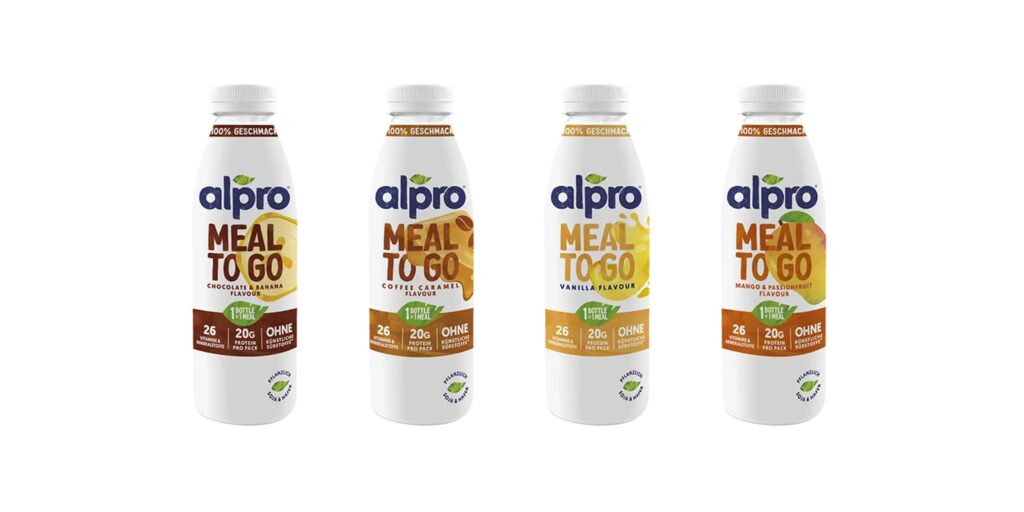
Alpro’s plant-based “Meal on the Go” drinks blend protein, fibre and micronutrients in a compact format. For people with reduced appetite on GLP-1 therapy, such nutrient-dense beverages can be a convenient way to preserve nutritional adequacy without large meals.
Olympos – Drink & Eat Meal

Olympos’ “Drink & Eat” range offers high-protein, drinkable meal formats rooted in dairy protein. Like liquid nutrition categories elsewhere, these products appeal to consumers seeking controlled portion formats with meaningful nutrient content.
Field Doctor – GLP-1-aligned specialist range

One of the first ranges in the UK marketed openly to people taking GLP-1 therapies is the Field Doctor range, which offers “GLP-1-aligned” nutrition products. These are formulated with controlled portions, protein prioritisation, and balanced macronutrients. While regulatory caution remains essential, this bespoke positioning highlights how specialist brands are navigating consumer interest within current legislative boundaries.
Functional ranges and plant-based eating: still siloed
A recurring pattern persists: functional innovation focused on protein, gut health, or satiety remains largely unintegrated with plant-based sustainability goals. Yet the overlap is obvious—nutrient-dense plant proteins paired with fibre and micronutrient-rich ingredients are inherently aligned with the eating behaviours seen among GLP-1 users.
With roughly 80% of UK food purchases coming from just 11 major supermarkets, retail decisions do not merely reflect food culture—they actively shape it. Shelf placement, pricing and marketing cues embed what feels normal, desirable and accessible.
GLP-1–related dietary change could be a catalyst for reframing plant proteins—beans, lentils, tofu and tempeh—as central to nutrient-dense eating.
The European regulatory challenge: can food be “GLP-1 friendly”?
Here, innovation encounters regulation.
EU law does not define or recognise “GLP-1-friendly” foods. Any such positioning would fall under strict rules governing food information and health claims:
- Regulation (EU) No 1169/2011 prohibits misleading labelling and forbids foods from being presented as preventing, treating or curing disease.
- Regulation (EC) No 1924/2006 allows only authorised nutrition and health claims.
At present, no authorised EU health claims relate to GLP-1 therapy, appetite suppression or weight loss in relation to food. Claims implying suitability for GLP-1 users could therefore be considered misleading, particularly given the absence of defined scientific criteria.
The parallel with the discontinued “suitable for diabetics” labelling is instructive. The European Commission concluded such claims were misleading because individuals with diabetes can consume all foods within a balanced diet. A similar regulatory logic would likely apply to GLP-1 users.
Any implication of therapeutic effect—explicit or implied—remains strictly prohibited.
Where responsible innovation can operate
For now, compliant innovation relies on authorised nutrition claims such as:
- “High protein”
- “Source of fibre”
- “Reduced energy”
The recent launches from M&S, Co-op, Morrisons, Alpro, Olympos, Iceland/Myprotein and Field Doctor demonstrate how brands are balancing relevance and regulation—signalling functionality without crossing into medical territory.
The European regulatory framework does not prevent innovation; it demands clarity, evidence and transparency.
GLP-1, plant-based diets and the bigger opportunity
From both nutrition and sustainability perspectives, the opportunity is significant. Evidence, including findings from the EAT-Lancet Commission, supports diets richer in plant-based foods for long-term health and reduced environmental pressure.
GLP-1–driven appetite changes create a practical context for this shift: when volume decreases, nutrient density matters more. Plant-based proteins paired with fibre-rich ingredients offer strong satiety and micronutrient value per calorie—well suited to smaller meals without animal defaults.
Retailers and manufacturers that embrace this convergence can help reshape normative food culture towards both health and sustainability without misleading claims.
Conclusion: innovation, trust and the future of GLP-1 foods
The emergence of GLP-1–influenced eating patterns shows how rapidly the food system adapts to health trends. The examples emerging across UK and European food innovation illustrate both agility and caution.
The regulatory framework does not block innovation—it safeguards consumer trust. Brands that work within authorised nutrition claims and transparent labelling can meet evolving demand responsibly.
The “GLP-1-friendly” conversation is only beginning. The real opportunity lies not in stretching claims, but in crafting nutrient-dense, functional and sustainable eating solutions that are evidence-based, regulatory compliant and genuinely empowering for consumers.
Nutricomms Opinion
GLP-1 medications are not just changing appetite — they are testing the intelligence of the food system.
Supermarkets have responded quickly: smaller portions, higher protein messaging, nutrient-dense positioning, drinkable formats and even structured support plans. This signals agility. But agility alone is not transformation.
Too often, innovation has defaulted to simply concentrating existing norms — especially animal-based protein — into smaller packs. In a lower-appetite environment, that is not enough. When volume declines, nutritional quality per bite becomes critical. Fibre, plant diversity, micronutrient density and protein distribution matter more than ever.
This is not a moment to miniaturise old models. It is a moment to redesign them.
The regulatory environment in Europe, often perceived as restrictive, is in fact a safeguard. Without authorised GLP-1-specific health claims, brands are required to innovate within evidence-based nutrition principles rather than marketing shortcuts. That discipline will ultimately define category credibility.
GLP-1 is not a passing trend. It represents a structural shift in how consumers relate to food. The real winners will not be those who shout “high protein” the loudest — but those who rethink what intelligent, sustainable and trustworthy eating looks like in a post-appetite economy.
References
- https://www.marksandspencer.com/food/content/how-to-eat-your-nutrients
- https://www.co-operative.coop/media/news-releases/co-op-launches-own-brand-glp-1-friendly-ready-meal-range-in-uk-convenience
- https://www.morrisons.com/inspiration/more-from-morrisons/health-hub/discover-our-exclusive-high-protein-everything-applied-nutrition-range
- https://www.myprotein.com/c/partnerships/iceland/
- https://www.alpro.com/es/productos/bebidas/meal-to-go-chocolate-banana
- https://vegconomist.com/food-and-beverage/beverages/alpro-plant-based-meal-replacement-drinks-protein/
- https://www.olympos.gr/en/products/drink-eat-en/
- https://www.fielddoctor.co.uk/range/glp1
