
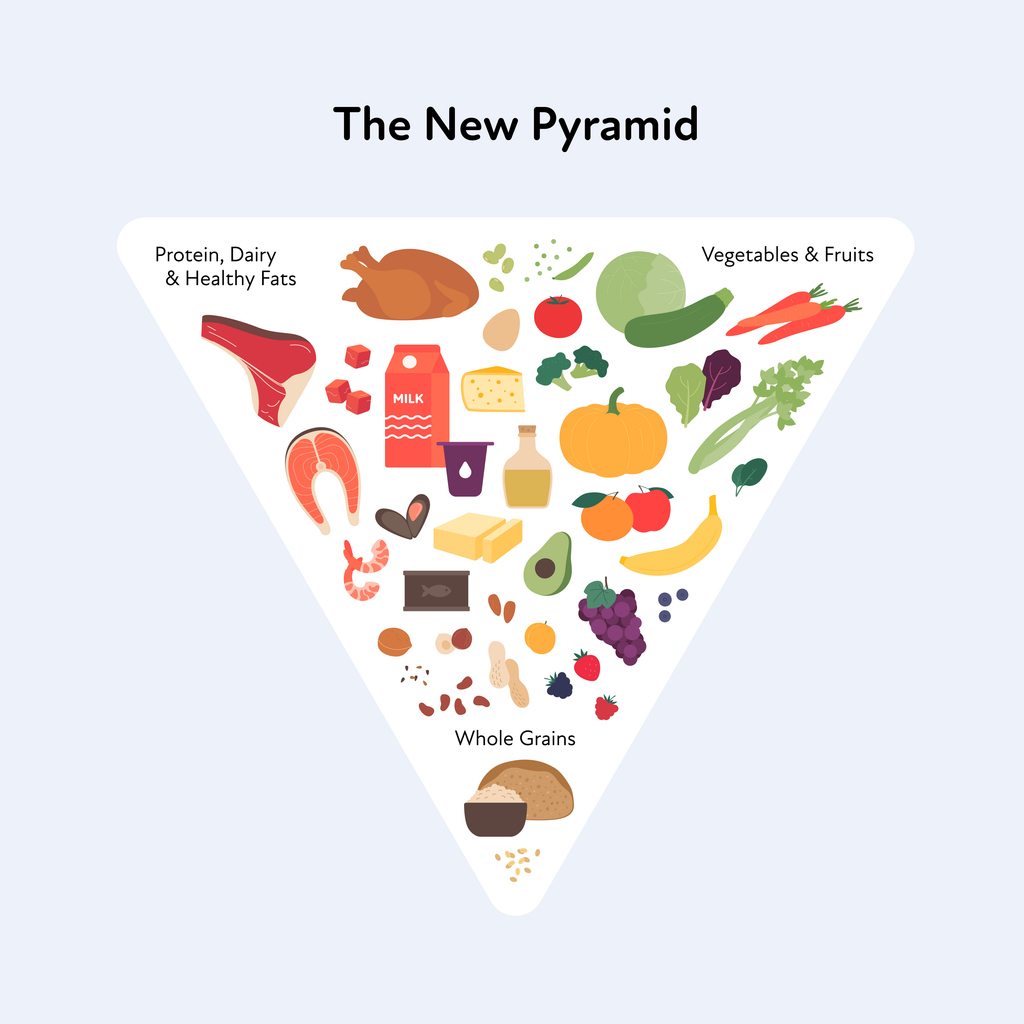
The 2025–2030 Dietary Guidelines for Americans (DGAs) have been positioned as a major reset of US nutrition policy, encouraging Americans to “eat real food” while taking a firmer stance on added sugars, refined carbohydrates, and highly processed foods. In several respects, this represents meaningful progress. Yet when the written recommendations are examined alongside the newly introduced Food Pyramid and accompanying policy commentary, a series of contradictions emerge—particularly around saturated fat, protein quantity, and protein quality.

The reintroduction of a pyramid-style visual—this time inverted—places meat, full-fat dairy, and vegetables at its widest point, with whole grains narrowed at the base. At first glance, this framing appears to elevate animal-based foods traditionally associated with higher saturated fat intake. Despite this, the DGAs formally retain the long-standing recommendation to limit saturated fat to less than 10% of total daily energy intake. The tension between these two messages is difficult to ignore.
Visuals versus science: why mixed messages matter
Public-facing dietary guidance relies heavily on visual shorthand. Taglines, graphics, and simplified frameworks often resonate more strongly than dense explanatory text. This is precisely why earlier evidence-based tools such as the Healthy Eating Plate were designed—to translate nutrition science into intuitive, actionable advice.
In the new DGAs, fruits and vegetables occupy a prominent role, aligning with scientific consensus. However, whole grains appear visually marginalised, despite recommendations of two to four servings per day. More notably, saturated-fat-rich foods such as red meat, cheese, whole milk, and butter receive visual prominence without adequate contextualisation. The risk is that consumers infer endorsement without recognising the constraints imposed by saturated fat limits.
- A tougher stance on highly processed foods—finally
One of the most substantive shifts in the 2025–2030 DGAs is the explicit discouragement of “highly processed foods.”While earlier editions emphasised whole foods and limits on sodium and added sugars, this is the first time a broader category of highly processed products is directly addressed.
The Guidelines advise avoiding sugar-sweetened beverages and salty or sweet packaged foods, and limiting ready-to-eat items containing artificial flavours, preservatives, petroleum-based dyes, and non-nutritive sweeteners. Grain guidance similarly prioritises whole, fibre-rich options while calling for a significant reduction in refined carbohydrates.
That said, the definition remains imprecise. The supplementary materials acknowledge that there is no consensus definition of ultra-processed foods, which leaves room for overgeneralisation. This is problematic, as some fortified or plant-based processed foods play an important role in reducing nutrient deficiencies and improving diet quality.
- Added sugars: strong language, weak translation to real life
The DGAs adopt their strongest language yet on added sugars, stating that “no amount of added sugars or non-nutritive sweeteners is recommended or considered part of a healthy or nutritious diet.” Practically, they advise that no single meal should exceed 10 grams of added sugar—a shift away from the previous population-level limit of 10% of daily energy intake.
Recommendations for children have also tightened, with avoidance of added sugars now advised until age 10 rather than age 2. While scientifically defensible, the Guidelines offer limited guidance on how these targets can be realistically implemented within current food environments, cultural practices, and socioeconomic realities.
- Saturated fat: technical alignment, practical contradiction
From an evidence perspective, the DGAs remain aligned with scientific consensus: the type of fat matters more than total fat intake, and replacing saturated fat with unsaturated fat improves lipid profiles and cardiovascular outcomes.
However, confusion arises in how “healthy fats” are framed. Animal-based foods higher in saturated fat—such as red meat, butter, and full-fat dairy—are grouped alongside plant-based fats that are predominantly unsaturated. The Guidelines stop short of clarifying which options should be prioritised to remain within the 10% saturated fat limit.
- When the maths doesn’t work
On a 2,000-calorie diet, 10% of energy from saturated fat equates to roughly 22 grams per day. The DGAs recommend three daily servings of dairy. Selecting full-fat versions—such as whole milk, full-fat Greek yogurt, and cheddar cheese—provides approximately 17 grams of saturated fat alone. Adding a tablespoon of butter or beef tallow, both suggested cooking fats, exceeds the limit before accounting for protein foods or additional meals.
Olive oil is presented as a preferred fat due to its “essential fatty acids,” yet it is relatively low in omega-3 and omega-6 fatty acids compared with oils such as soybean or canola oil—both of which have strong evidence for reducing LDL cholesterol when replacing animal fats. This nuance is largely absent from the consumer-facing guidance.
- Protein: more focus, less clarity
Protein sits at the centre of the new Guidelines. Adults are now advised to consume 1.2–1.6 g of protein per kilogram of body weight per day, representing a 50–100% increase over previous minimum intake recommendations. This shift has raised concern among nutrition scientists, given that most Americans already meet or exceed protein requirements.
What is notably under-emphasised is protein quality and source. When protein intake increases without clear differentiation between animal and plant sources, overall saturated fat intake may rise—directly conflicting with other elements of the DGAs.
The concept of the protein “package” is critical here. A 4-ounce sirloin steak delivers around 33 g of protein, but also about 5 g of saturated fat. A cup of cooked lentils provides 18 g of protein, 15 g of fibre, and virtually no saturated fat. These distinctions have profound implications for cardiometabolic health but receive limited attention in the Guidelines.
- Plant-based proteins: scientific advice sidelined
Perhaps the most contentious aspect of the 2025–2030 DGAs is the decision to reject the scientific advisory committee’s recommendation to prioritise plant-based proteins and reduce red and processed meat intake. The supplementary appendix explicitly criticises previous guidance for encouraging plant-forward dietary patterns, arguing that such approaches risk reducing “protein density and quality” and increasing carbohydrate intake beyond requirements.
This position runs counter to a growing body of evidence—and international policy trends. Countries including Finland, Norway, Germany, Austria, and the Netherlands have updated their dietary guidelines to encourage a shift toward plant-based proteins, a move reinforced by the Eat-Lancet Commission’s Planetary Health Diet.
Despite acknowledging vegetarian and vegan dietary patterns as viable, the DGAs continue to prioritise animal proteins. Plant-based meat alternatives are largely discouraged due to their classification as “highly processed,” while legumes, nuts, seeds, soy, tofu, tempeh, and mycoprotein receive more cautious endorsement. Fortified dairy alternatives are mentioned, but not actively prioritised.
- Alcohol and sustainability: still under-addressed
On alcohol, the DGAs advise Americans to “consume less alcohol for better health,” without defining actionable limits—leaving interpretation open and guidance vague.
Equally notable is the continued absence of environmental sustainability considerations. Food systems significantly influence climate outcomes, land use, and economic resilience, yet these dimensions remain excluded from national dietary guidance, limiting its relevance in a rapidly changing global context.
Bottom line
The 2025–2030 Dietary Guidelines for Americans make clear progress in addressing added sugars and calling out highly processed foods. Technically, they remain aligned with scientific consensus on saturated fat limits. However, contradictions between written recommendations, visual messaging, and policy positioning—particularly around protein quantity, protein sources, and full-fat animal products—risk undermining that progress.
As the Guidelines become shorter, more visual, and more consumer-facing, clarity and consistency matter more than ever. Without them, mixed messages may continue to erode public trust and adherence. For individuals and organisations navigating this complexity, evidence-based tools such as the Healthy Eating Plate—and personalised guidance from registered dietitians—remain essential anchors in an increasingly politicised nutrition landscape.
Nutricomms opinion: When policy clarity matters more than ever
From a nutrition science perspective, the 2025–2030 Dietary Guidelines for Americans are not entirely misaligned with evidence. On paper, limits on saturated fat remain intact, added sugars are more clearly discouraged, and whole foods are prioritised. However, nutrition policy is only as effective as its clarity, and clarity is where these Guidelines fall short.
At Nutricomms, we see this repeatedly: people do not eat nutrients, percentages, or appendices—they eat foods, influenced by visuals, headlines, and simplified takeaways. When the imagery and framing elevate red meat, butter, and full-fat dairy without equally explicit guardrails, nuance is lost. The result is not informed choice, but confusion.
Equally concerning is the sidelining of well-established evidence on protein quality and plant-based protein sources. Encouraging higher protein intake in a population that already consumes more than enough—without clear differentiation between sources—risks exacerbating the very health outcomes the Guidelines aim to address. Protein quantity without context is not progress; it is noise.
The stronger stance on highly processed foods is welcome, but the absence of a precise definition—and the failure to distinguish between nutritionally beneficial processed foods and those that undermine diet quality—creates further ambiguity. Blanket condemnation may resonate politically, but it does little to support practical, inclusive, or equitable dietary change.
Most critically, the Guidelines continue to treat nutrition as if it exists in isolation from environmental sustainability, food systems resilience, and socioeconomic reality. In 2026, this is no longer defensible. Dietary guidance that ignores planetary and economic constraints risks becoming obsolete before it is even implemented.
Our view is simple:
effective dietary guidance must be scientifically rigorous, visually coherent, and context-aware. Without alignment between evidence, messaging, and real-world application, even well-intentioned recommendations struggle to drive meaningful change.
References
